
"I bought ten times and got eight right." Hearing this feels like real skill. That's an 80% win rate. Yet this person's account may be in the red. Conversely, there are people who get only three of ten right and still make a lot.
How is this possible? The answer is that win rate alone can't tell you an investment's results. Today we lay out how win rate and payoff ratio, these two numbers, move together.
What the Two Numbers Are — in One Sentence
Win rate is the share of winning trades among all trades. Seven wins out of ten is a 70% win rate.
Payoff ratio is the ratio of how much you make on average when you win to how much you lose on average when you lose. If you make +300 on average when you win and lose −100 on average when you lose, the payoff ratio is 3.
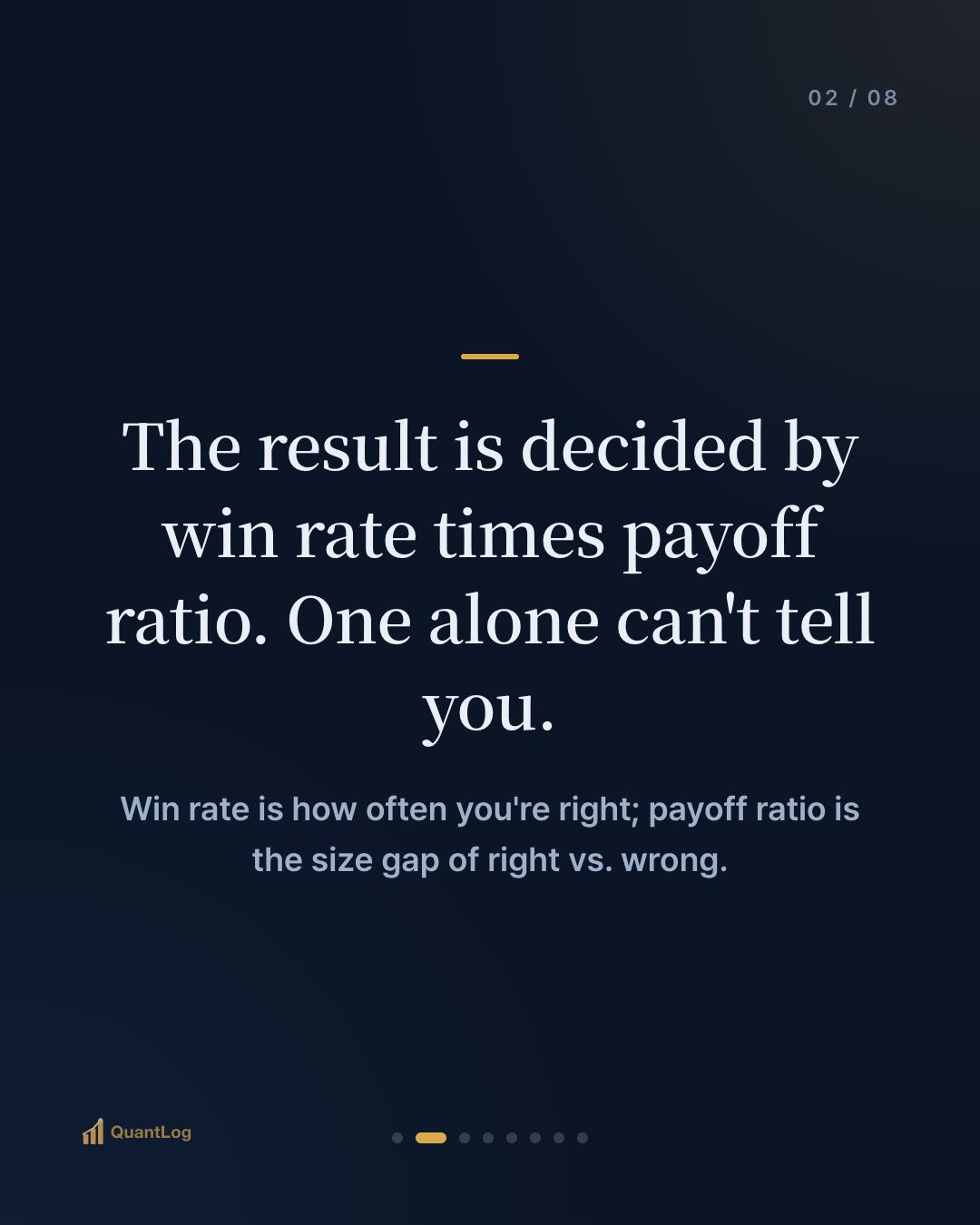
Win rate is "how often you're right"; payoff ratio is "the size difference between being right and being wrong." Your final result is decided by the product of the two. You can never tell from just one.
Why Win Rate Alone Isn't Enough
Let's look at a simple example.
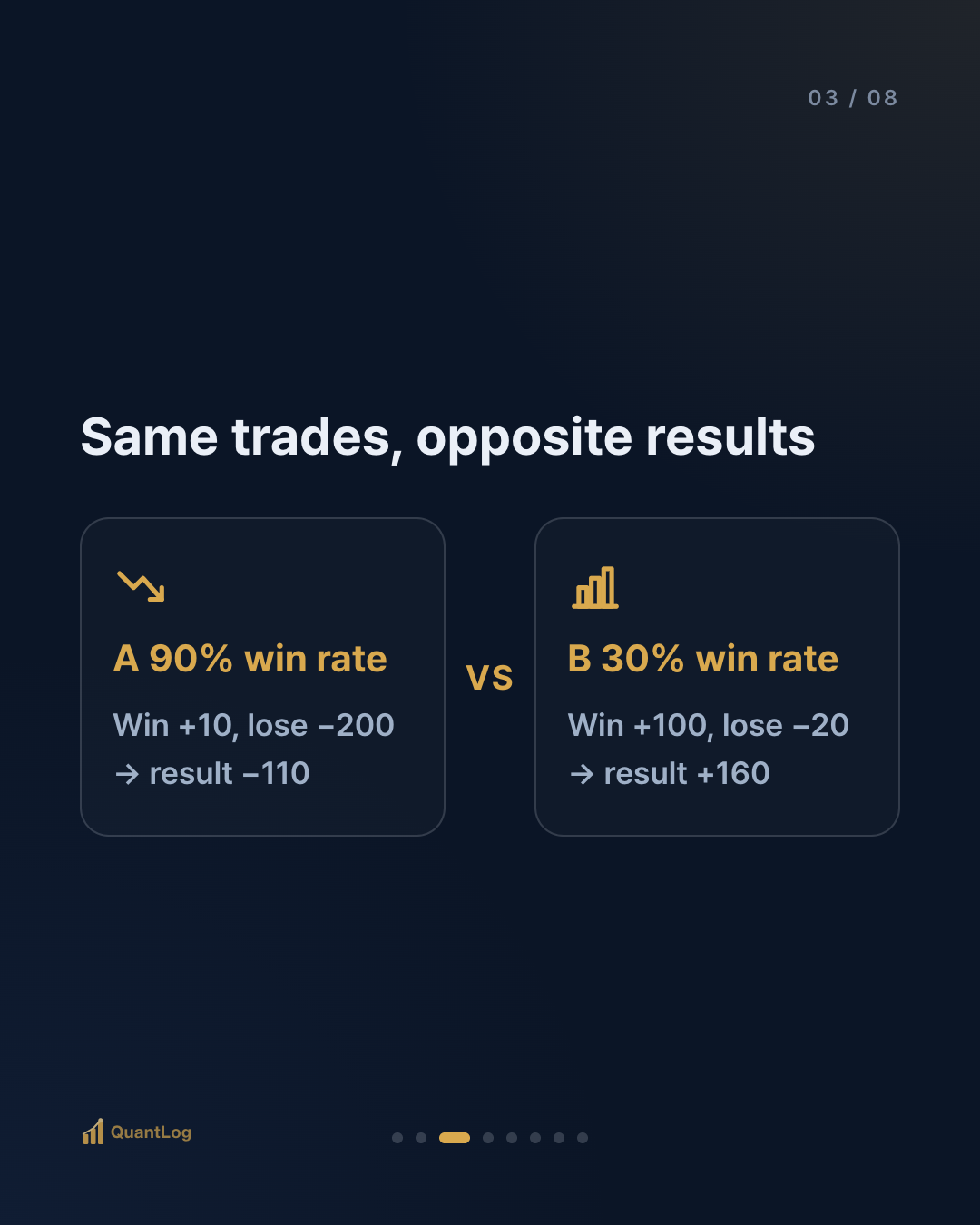
A: 90% win rate, low payoff ratio. You get nine of ten right, but you make a little when you win (+10) and lose big on the one loss (−200). Nine wins make 90, one loss takes 200. The result is −110. The win rate is dazzling, but the account melts.
B: 30% win rate, high payoff ratio. You get only three of ten right, but you make big when you win (+100) and lose small when you lose (−20). Three wins make 300, seven losses take 140. The result is +160. The win rate is low, but the account grows.
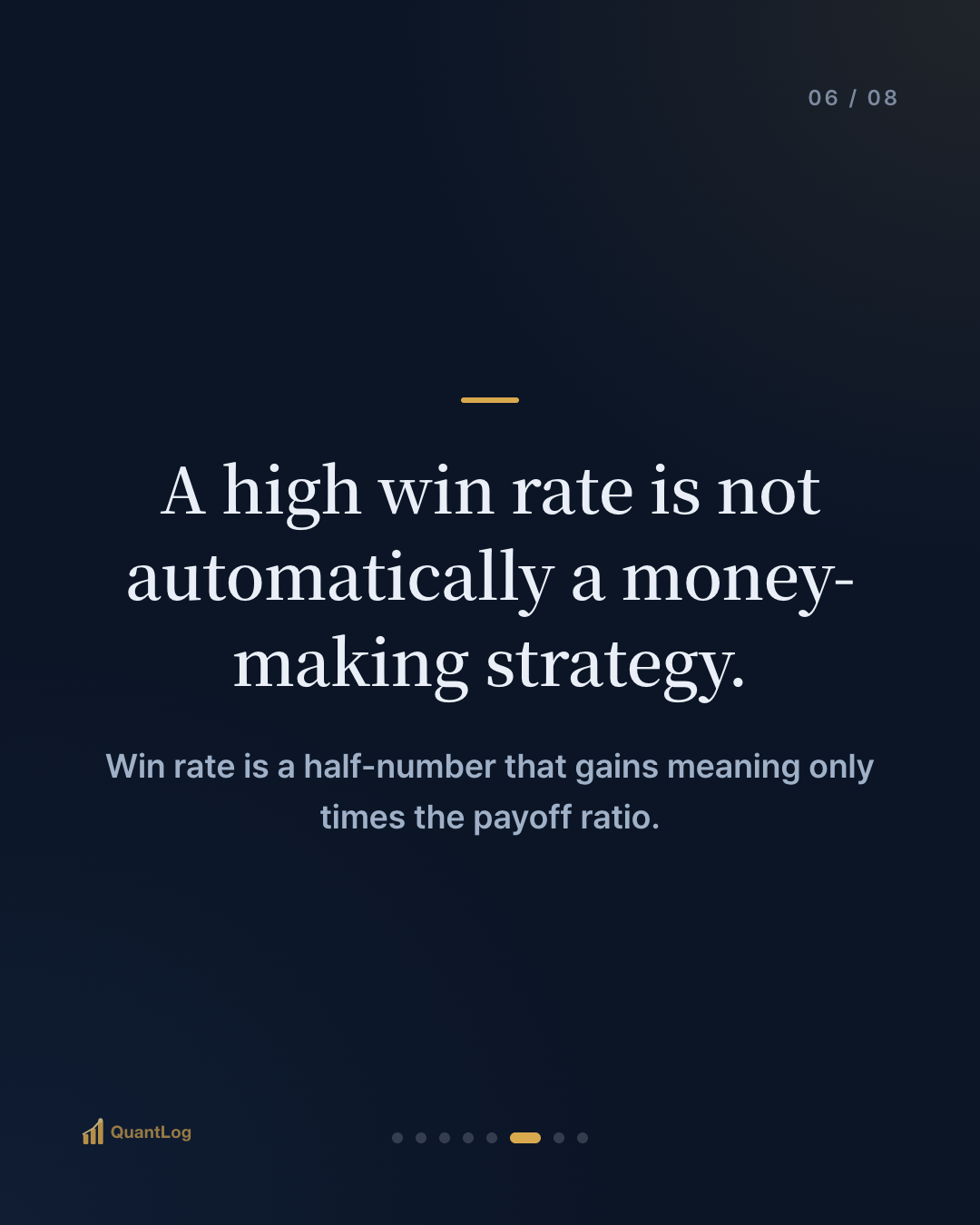
This is the crux. A high win rate is not automatically a money-making strategy. Only by looking at win rate and payoff ratio together, and only when their product is positive, does it become meaningful.
The Two Are Usually a Trade-Off

Here's an interesting fact. Win rate and payoff ratio often move in opposite directions.
Chasing a high win rate usually means taking profits early (small gains) and holding losses long (big losses). You're right often, but a single loss is large. The payoff ratio falls.
Chasing a high payoff ratio means aiming for big trends and cutting losses fast. You win big, but most attempts end in small losses, so the win rate falls. Trend-following strategies are the classic "low win rate, high payoff ratio" shape.
So "raise the win rate or the payoff ratio" isn't a matter of choosing one of the two — it's a matter of which combination makes the product positive.
What to Watch in Practice

There are common traps when looking at these two numbers.
① With a small sample, neither can be trusted. A win rate and payoff ratio from ten or twenty trades are likely chance. Only after enough trades accumulate does the number begin to reflect skill.
② The average hides the distribution. The payoff ratio is the ratio of "average" gain to "average" loss. But a single huge win can pull the average up, making a strategy that mostly loses look good. You have to look at the distribution behind the average.
③ Psychological sustainability. A 30% win-rate strategy may be good in theory, but you can lose seven times in a row. If you can't endure that losing streak, you can't keep even a good strategy. The numerical optimum and what you can actually keep are different.
To Sum Up
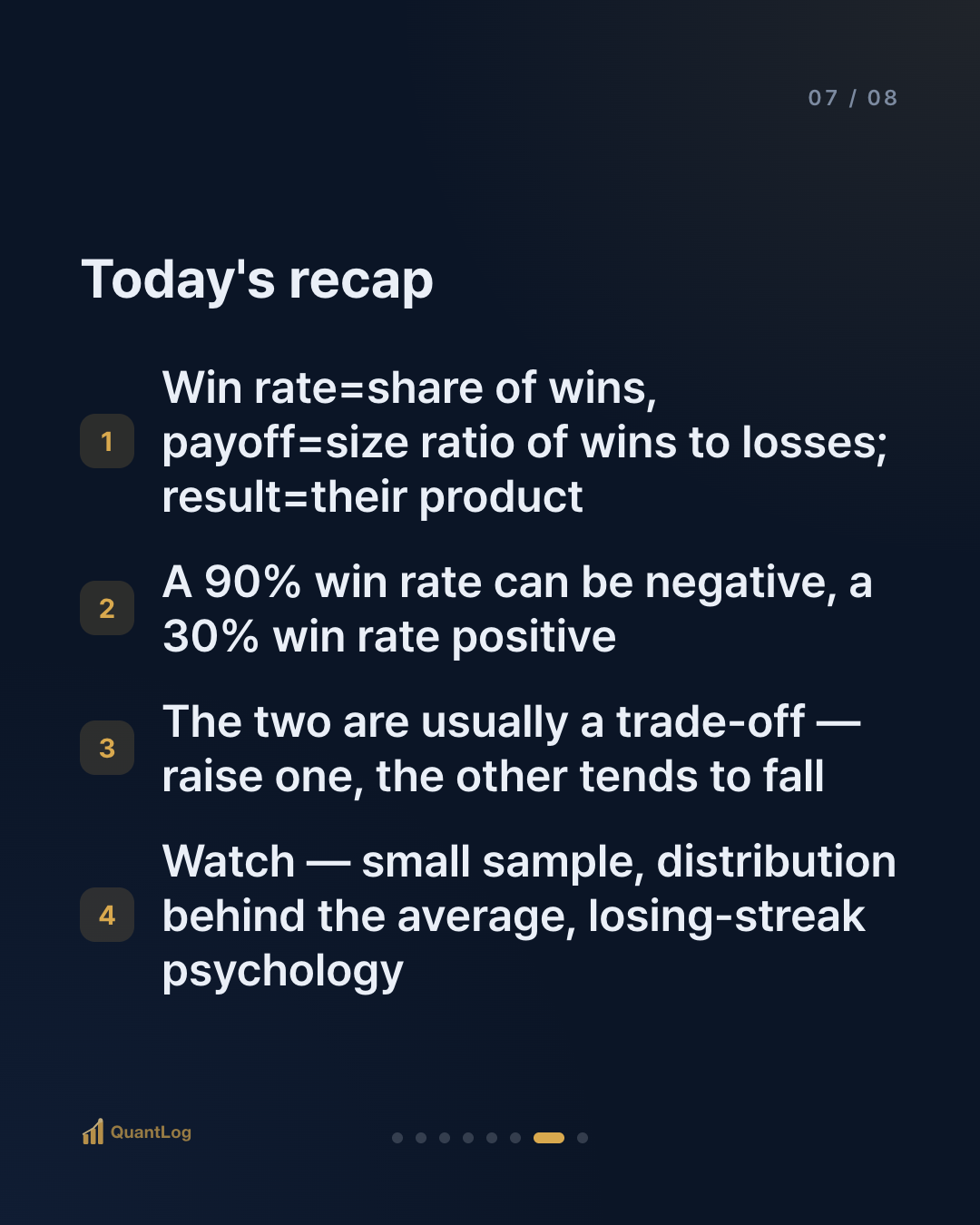
- Win rate = the share of winning trades; payoff ratio = the size ratio of wins to losses. The result is decided by their product
- A high win rate isn't automatically a profit. A 90% win rate can be negative, a 30% win rate positive
- The two are usually a trade-off. Raise the win rate and the payoff ratio tends to fall, and vice versa
- What to watch: a small sample, the distribution the average hides, and the psychology of enduring losing streaks
"How many times you were right" is only half the story. Only by also looking at the other half — "how much you make when right and lose when wrong" — can you tell whether a strategy actually makes money. Win rate isn't a thing to boast about; it's a half-number that gains meaning only when multiplied by the payoff ratio.
References
- Expectancy = win rate × average gain − (1 − win rate) × average loss. This identity binds the two indicators into one
- Tharp, V., *Trade Your Way to Financial Freedom* (1998) — performance evaluation from an expectancy / R-multiple view
- The Kelly criterion (Kelly, 1956) also uses win rate and payoff ratio together to set bet size

Disclaimer
This article is for informational purposes only and is not investment advice. It is not a recommendation to buy or sell any security. All investment decisions are your own responsibility.

Comments 0
Be the first to comment.