
"Don't put all your eggs in one basket." It's the most-heard advice in investing. But then, how many baskets should you split into? Three? Or do you need a hundred? It feels like piling on more stocks would keep cutting risk forever, but in reality it doesn't.
Today we lay out how far diversification cuts risk, and where the effect stops.
The Risk Diversification Cuts, and the Risk It Can't
First you need to know that risk comes in two kinds.
① Idiosyncratic risk (unsystematic risk). Risk that arises only for a specific company: an earnings shock, owner risk, a factory fire. Spread across many stocks, these offset one another and shrink. Even if one stock collapses, the others hold you up.
② Market risk (systematic risk). Risk that hits the whole market: rate hikes, a recession, war. No matter how many stocks you add, this doesn't disappear. If the market falls as a whole, holding 100 stocks falls right along with it.
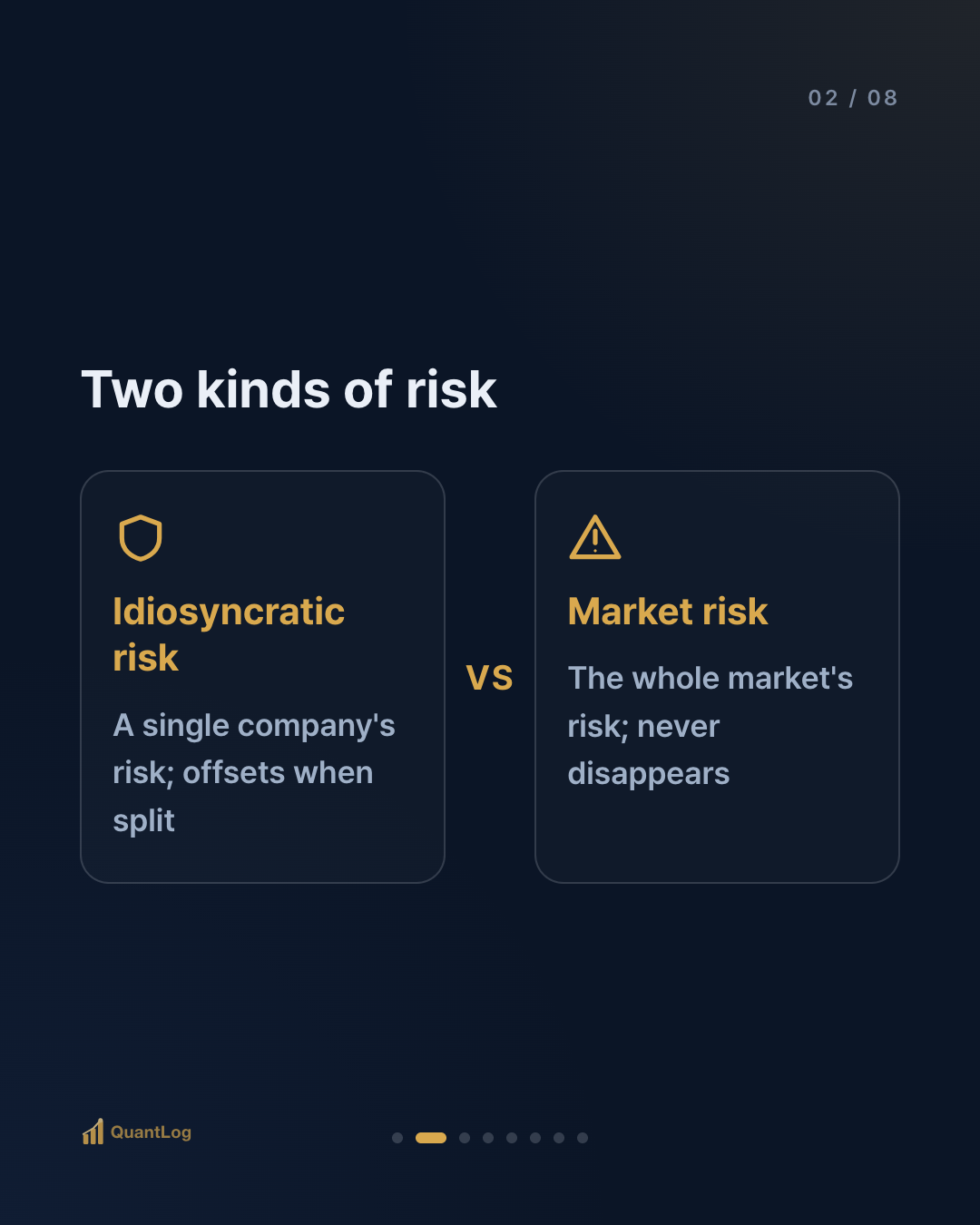
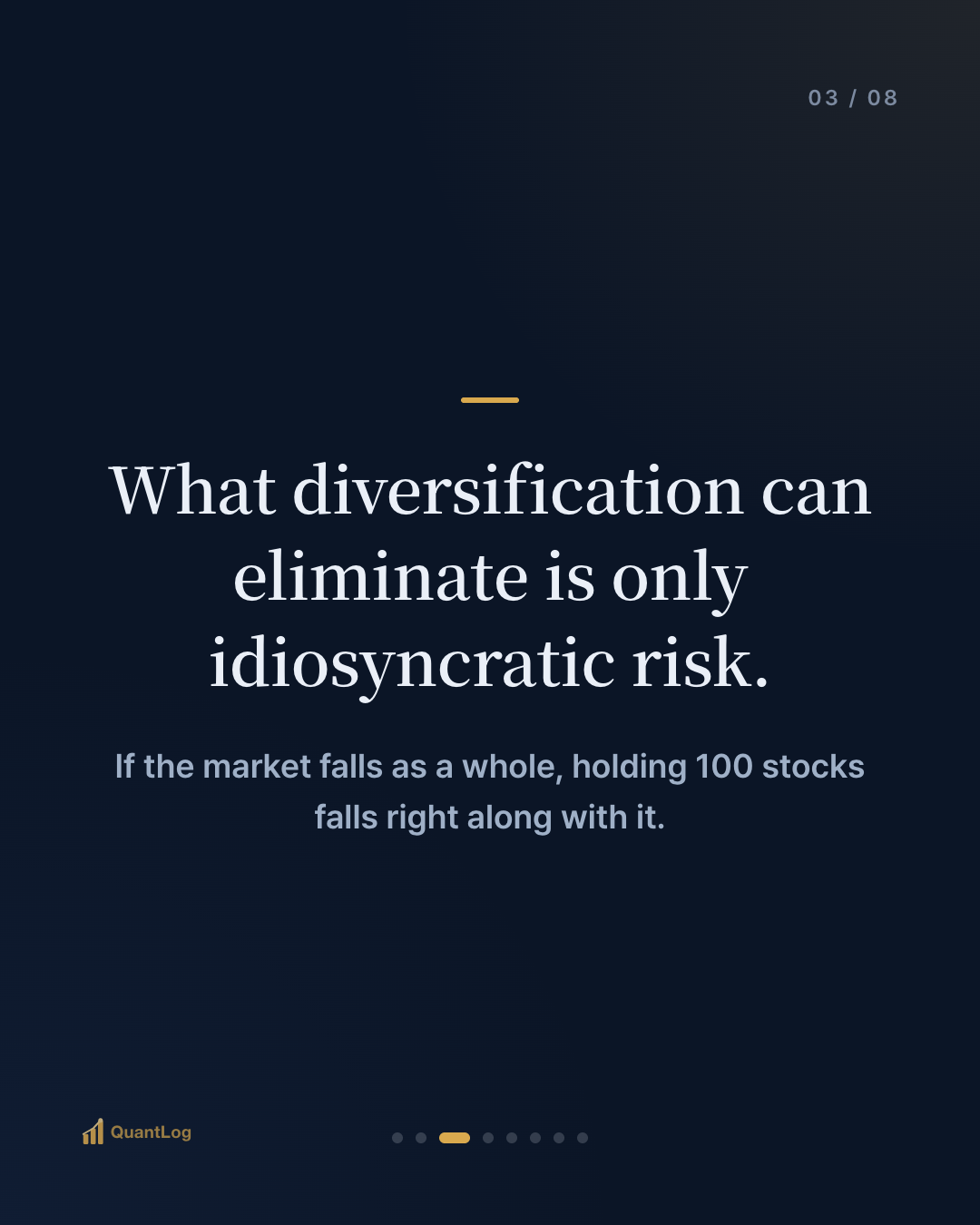
What diversification can eliminate is only ① idiosyncratic risk. And from here comes the answer to "from how many stocks."
The Effect Stops Sooner Than You'd Think
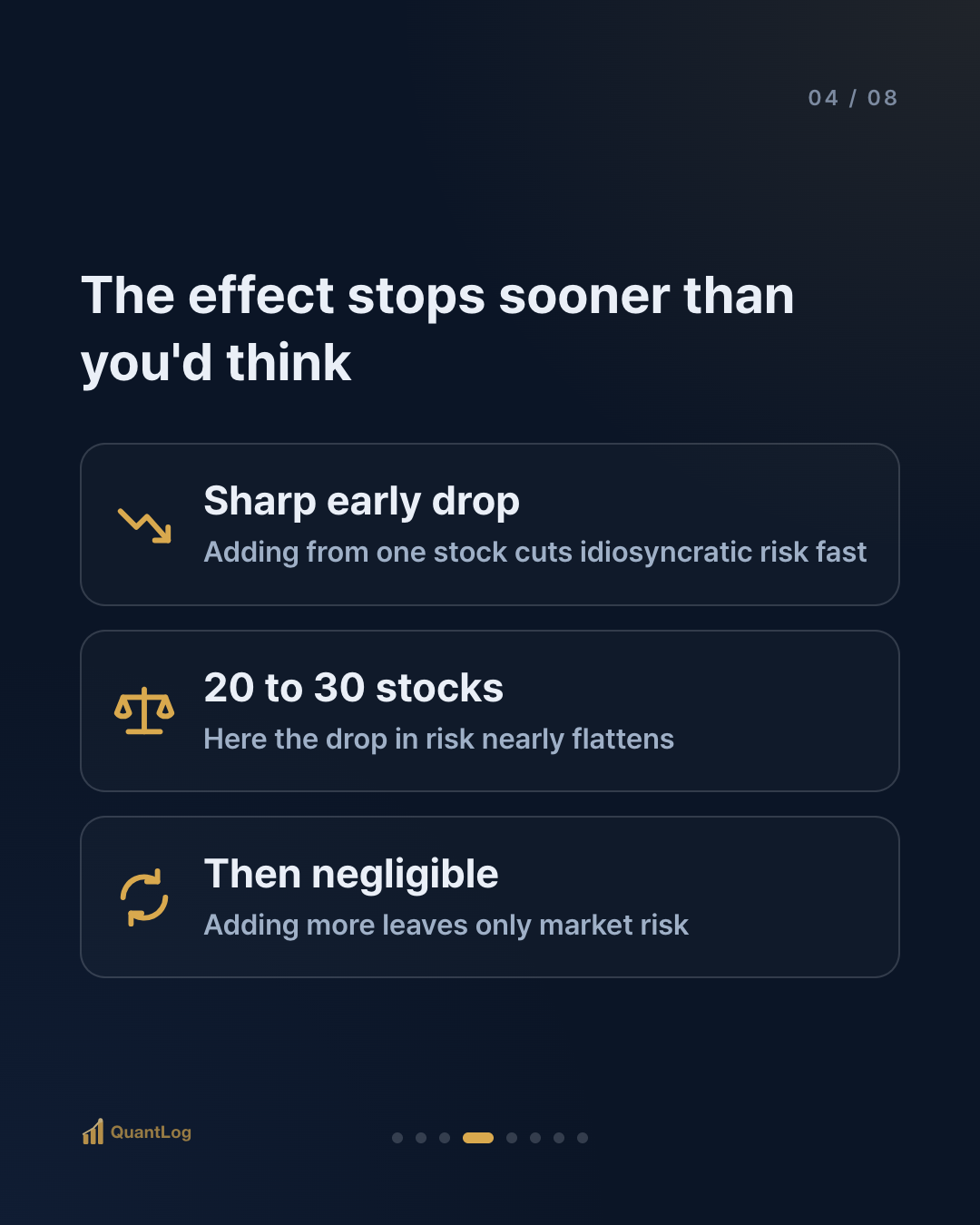
Intuitively, it feels like more stocks would keep cutting risk. But the actual curve drops fast and then quickly flattens.
Classic studies see it roughly like this. Starting from one stock and adding more, idiosyncratic risk falls sharply, but around 20 to 30 stocks that decline nearly stops. Beyond that, adding more stocks trims only a negligible amount of risk. What's left is the market risk that never disappears no matter how many you add.
So "eggs in many baskets" is right, but it means you don't need infinitely many baskets. Splitting into just a handful, done well, already removes most idiosyncratic risk.
So Is More Always Worse?
That doesn't make 100 stocks wrong. But you have to know that marginal benefit falls off sharply.
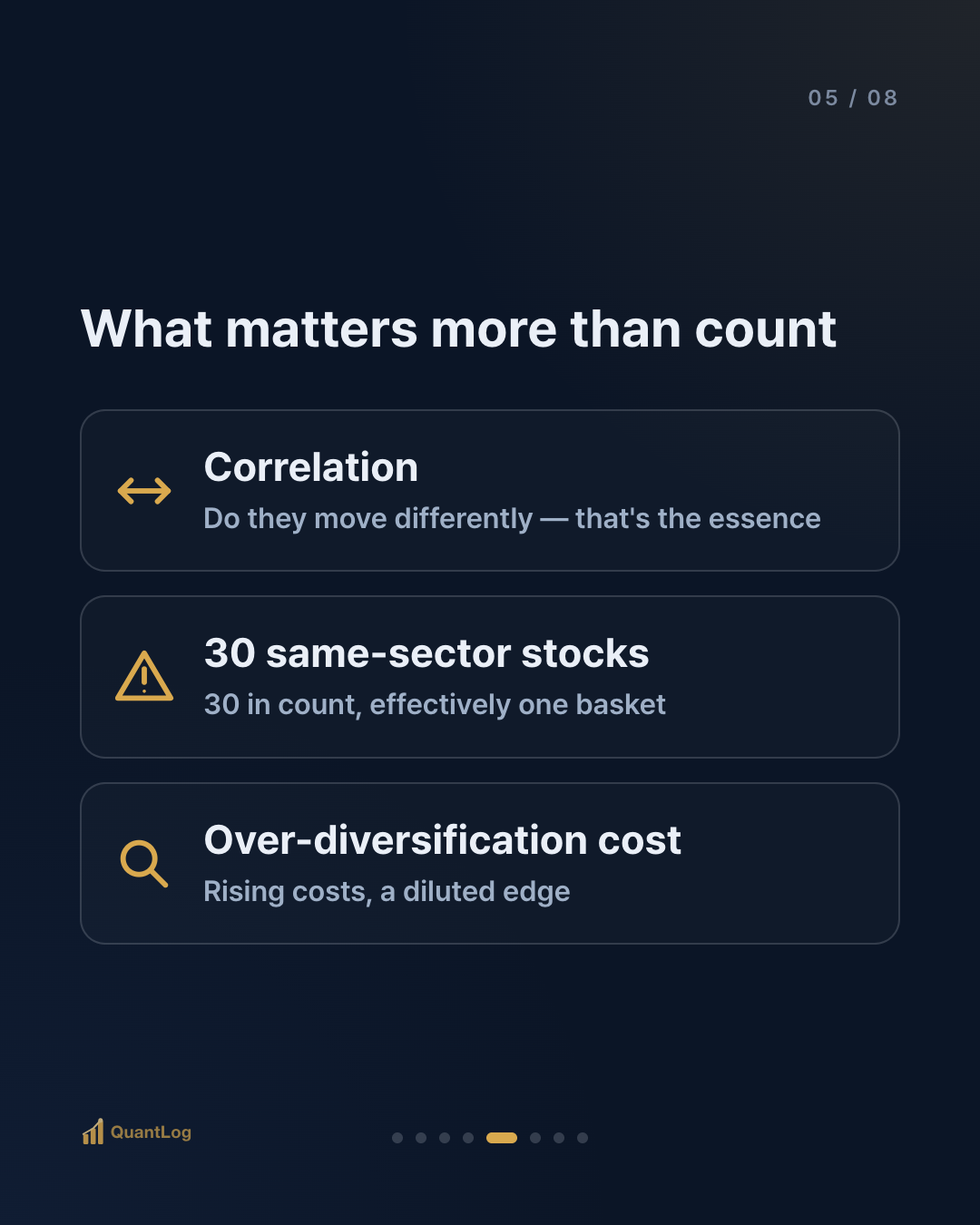
The cost of over-diversification. Too many stocks and you can't properly examine each one, and any edge from the few you know well gets diluted. Management and transaction costs rise too. So beyond a point, adding stocks enters a zone where "risk barely drops but management just gets harder."
What really matters is correlation. There's something more important than the number of stocks: do they move differently? Thirty stocks in the same sector are 30 in count but effectively close to one basket. Conversely, five stocks of different character can diversify better. Not the count but low correlation is the essence of diversification.
So, How Many Stocks?
There's no single right answer, but the principle is clear.
If you invest directly in individual stocks, most idiosyncratic risk is often seen as removed somewhere around 15 to 30 stocks of differing character. Beyond that is the zone where management burden grows faster than risk falls.
There's a simpler path too: holding a whole index. Buy the entire market and hundreds of stocks are included automatically, so idiosyncratic risk is effectively gone and only market risk remains. It's a way to get the effect of diversification without an individual computing correlations one by one. But remember this too still leaves market risk itself in place.
To Sum Up
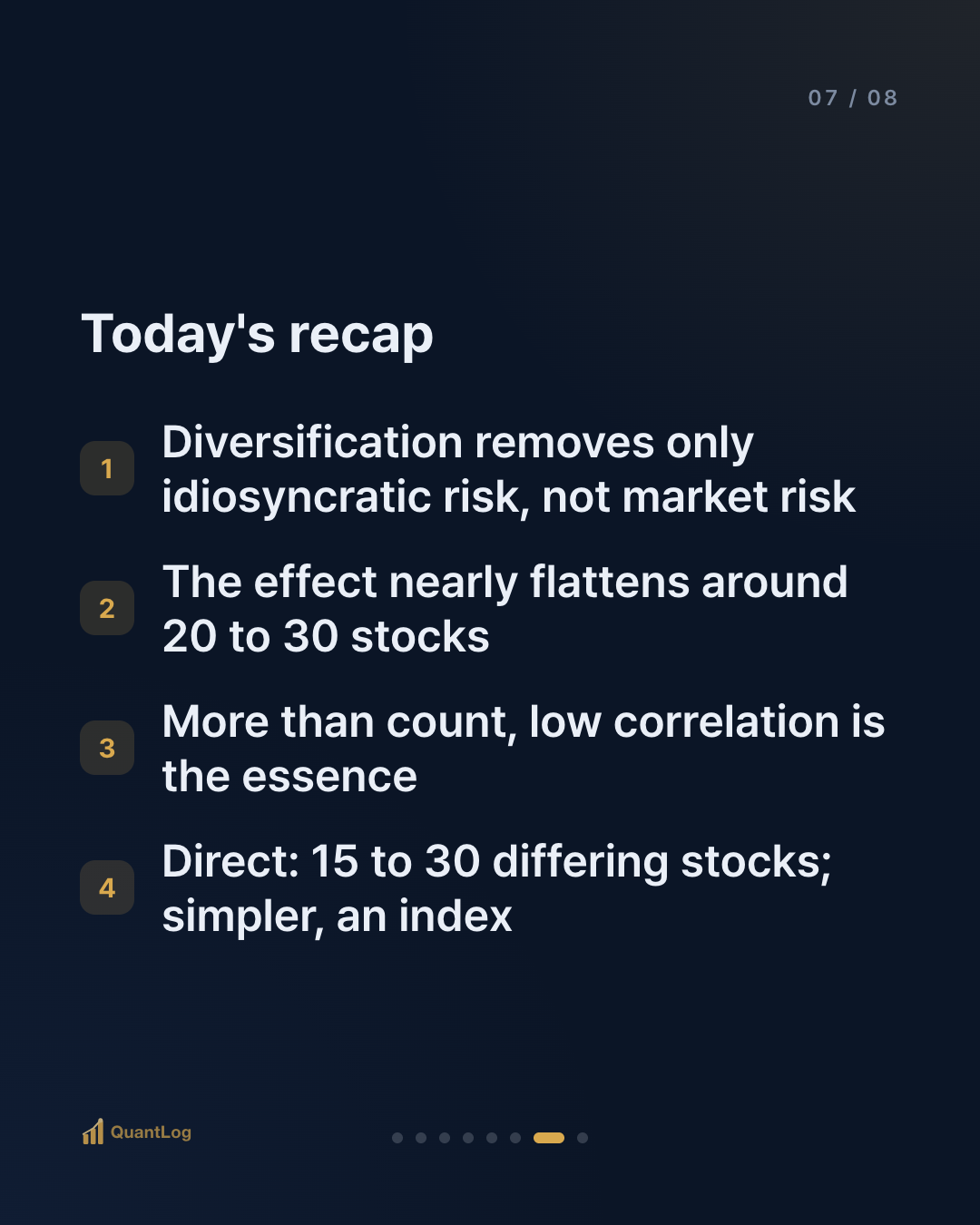
- Two kinds of risk. Diversification removes only idiosyncratic risk; it can't remove market risk
- The effect stops early — roughly around 20 to 30 stocks the drop in idiosyncratic risk nearly flattens
- More than count, correlation is the essence. Thirty same-sector stocks are effectively close to one basket
- Direct investing: 15 to 30 stocks of differing character; simpler still, an index. But market risk remains
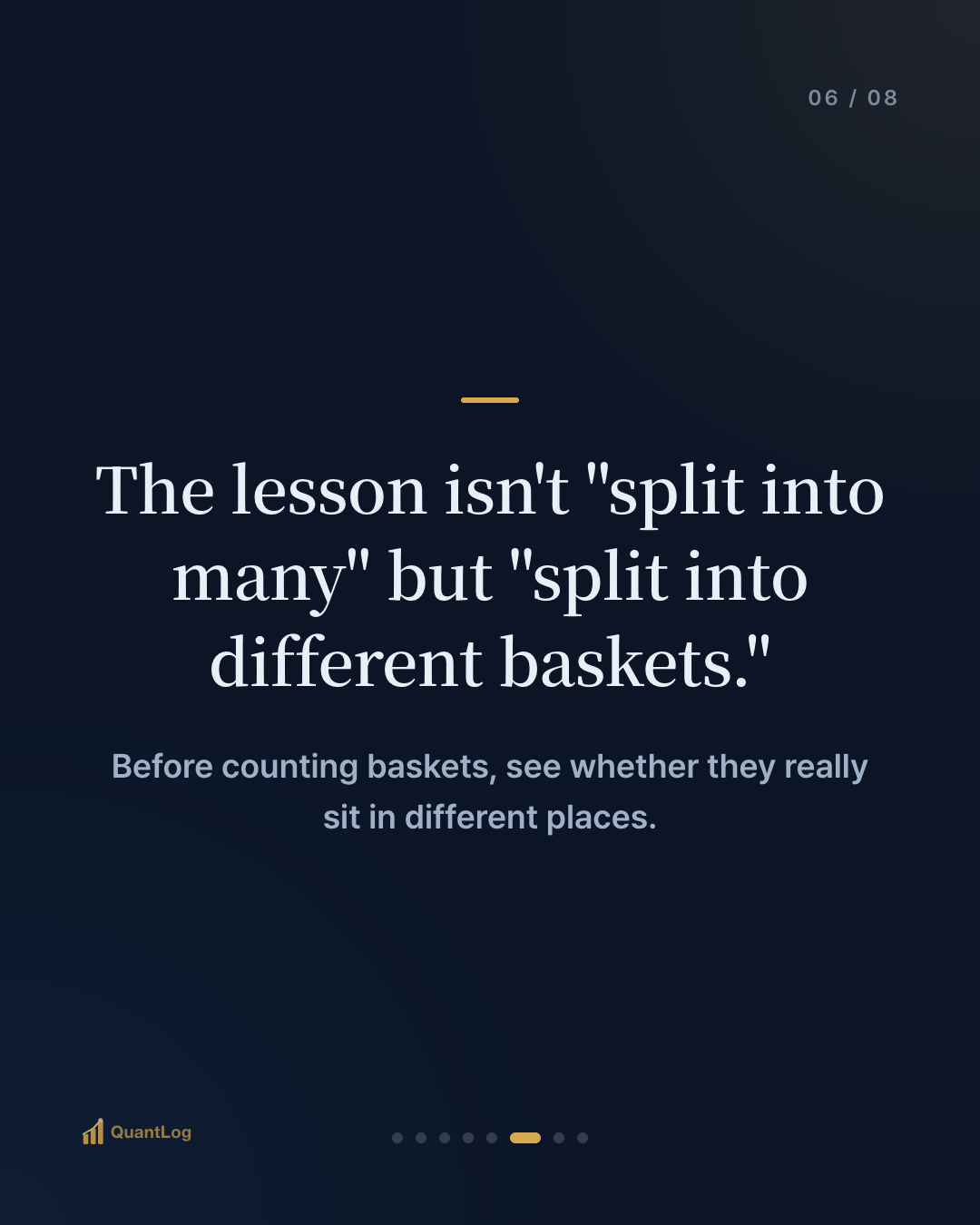
The real lesson of eggs and baskets isn't "split into many" but "split into different baskets." Before counting baskets, look first at whether those baskets really sit in different places.
References
- Evans & Archer, "Diversification and the Reduction of Dispersion," *Journal of Finance* (1968) — the diminishing return of stock count on risk reduction
- Statman, M., "How Many Stocks Make a Diversified Portfolio?," *Journal of Financial and Quantitative Analysis* (1987) — the debate on how many stocks diversification needs
- The distinction between systematic and unsystematic risk is a basic framework of modern portfolio theory

Disclaimer
This article is for informational purposes only and is not investment advice. It is not a recommendation to buy or sell any security. All investment decisions are your own responsibility.

Comments 0
Be the first to comment.