
"Institutions buy off VWAP." It's a line that circulates half like myth in trading circles, along with the simple rule that above VWAP is bullish and below is bearish. But once you know what VWAP actually calculates, and why institutions care about it, you can use this indicator far more accurately.
Today we lay out what kind of average VWAP is, what it's used for, and where individuals commonly misread it.
What VWAP Is — in One Sentence
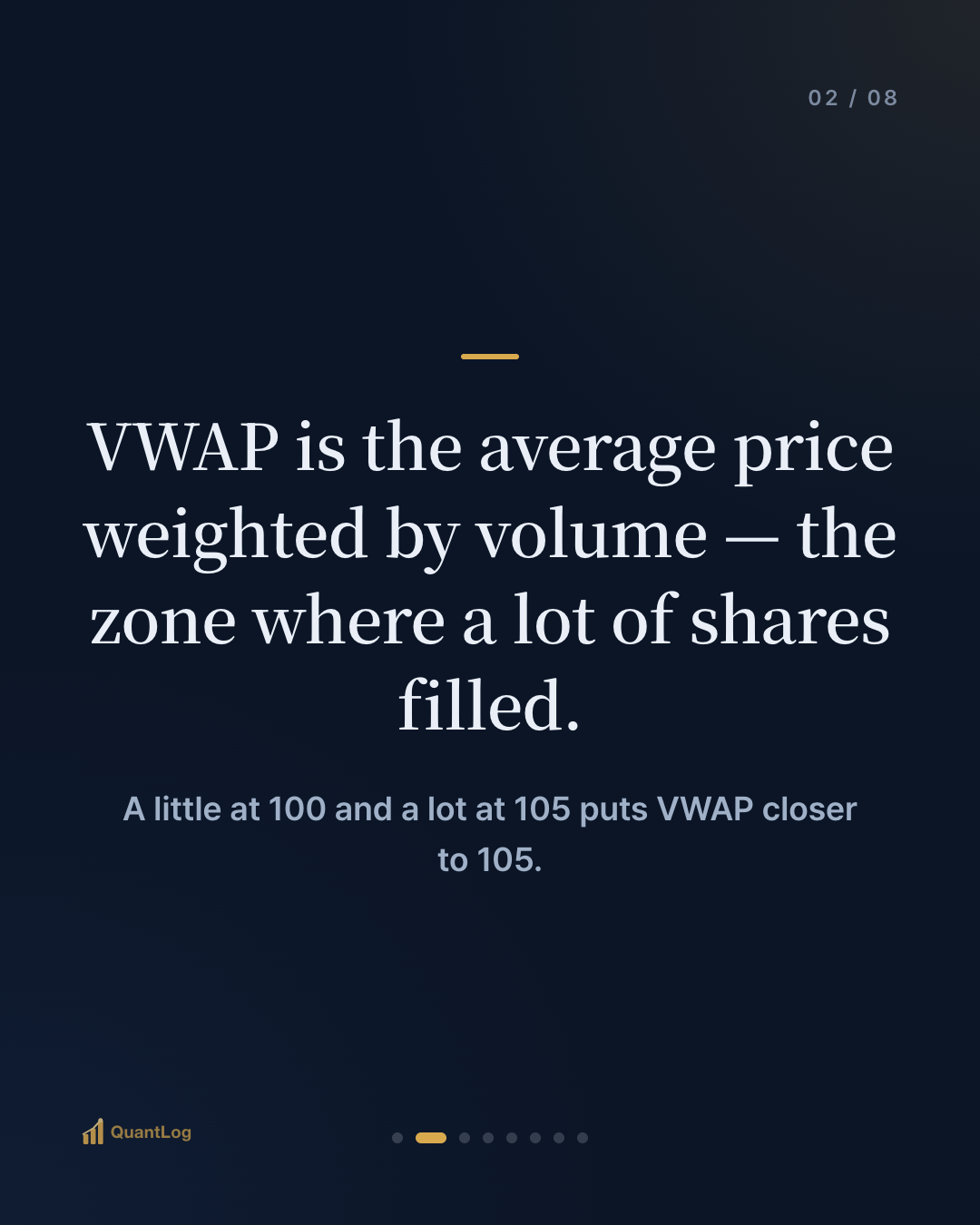
VWAP (Volume Weighted Average Price) is, just as the name says, the average price weighted by volume. Rather than simply averaging closing prices, it gives more weight to the prices where a lot of trading happened.
Conceptually the calculation is this: over the day, multiply the price at each moment by the volume at that moment, add them all up, and divide by the day's total volume. So it's "the average price zone where a lot of shares actually filled." If a small amount traded at 100 and a large amount at 105, VWAP isn't the simple average of 102.5 but sits closer to 105.
Why Institutions Watch VWAP
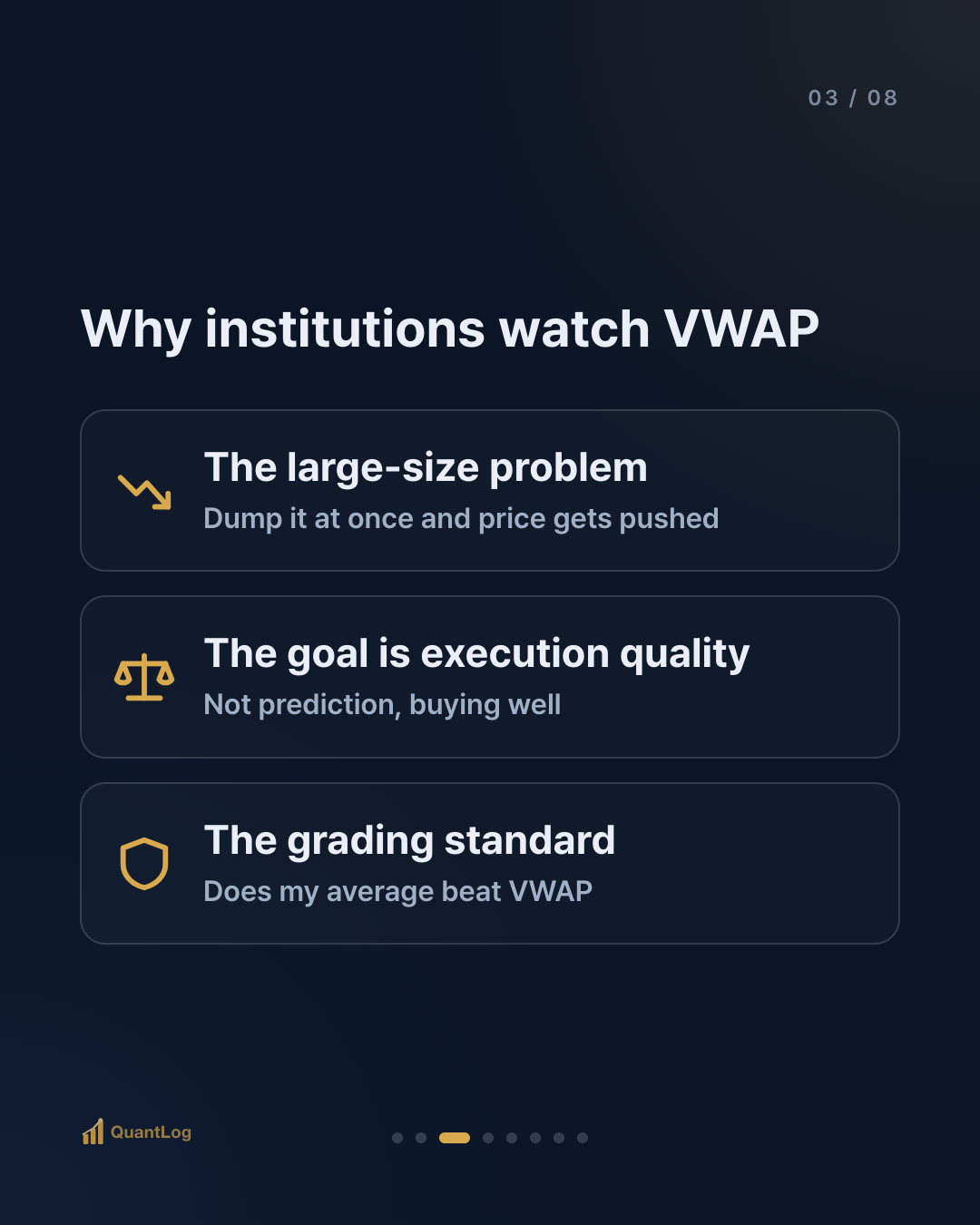
An individual buys a few shares, or a few dozen. An institution buys and sells a single stock hundreds of thousands or millions of shares at a time. Dump that large size all at once and the price gets pushed hard. So an institution's goal is often not "prediction" but "execution quality."
This is where VWAP enters. Because VWAP is a benchmark line for the day's average fill price, whether the average price you paid beats VWAP becomes the yardstick for measuring execution skill. Buy below VWAP and you bought better than the day's average; buy above and the market pushed you.
So to an institution, VWAP is not a prophetic tool for calling direction but a benchmark that grades its own execution. That difference is the crux. VWAP's original purpose is not "when to buy" but "how well did I buy."
Common Misreadings by Individuals
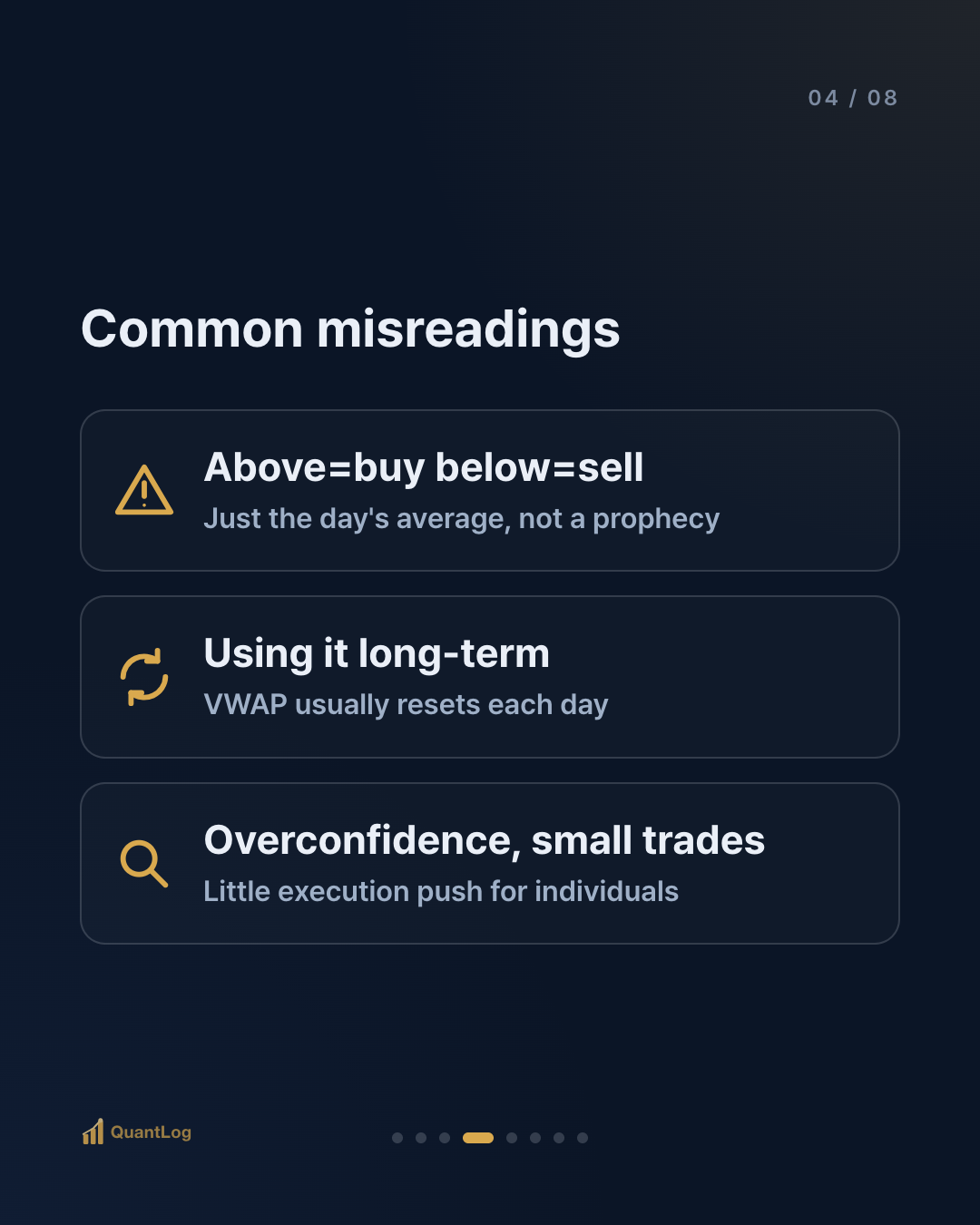
Miss this original purpose and you misfire on three counts.
① The simple above-VWAP-buy, below-VWAP-sell rule. VWAP is just the day's average; it doesn't state a future direction. Price being above VWAP is a fact — "right now is more expensive than today's average" — not a prophecy that it goes higher.
② Using it as a long-term indicator. VWAP usually resets each day. It starts accumulating again at the open, so it's not naturally suited to judging trends over days or weeks. There are variants like the anchored VWAP that span multiple days, but the basic VWAP is intraday.
③ Overconfidence in small individual trades. VWAP is a tool for measuring the quality of large fills. For an individual buying a few shares, there's almost no execution push, so it doesn't carry the decisive meaning it does for institutions. It's useful as a reference line, but the grounds for revering it beyond that are thin.
If It Still Has a Use for Individuals
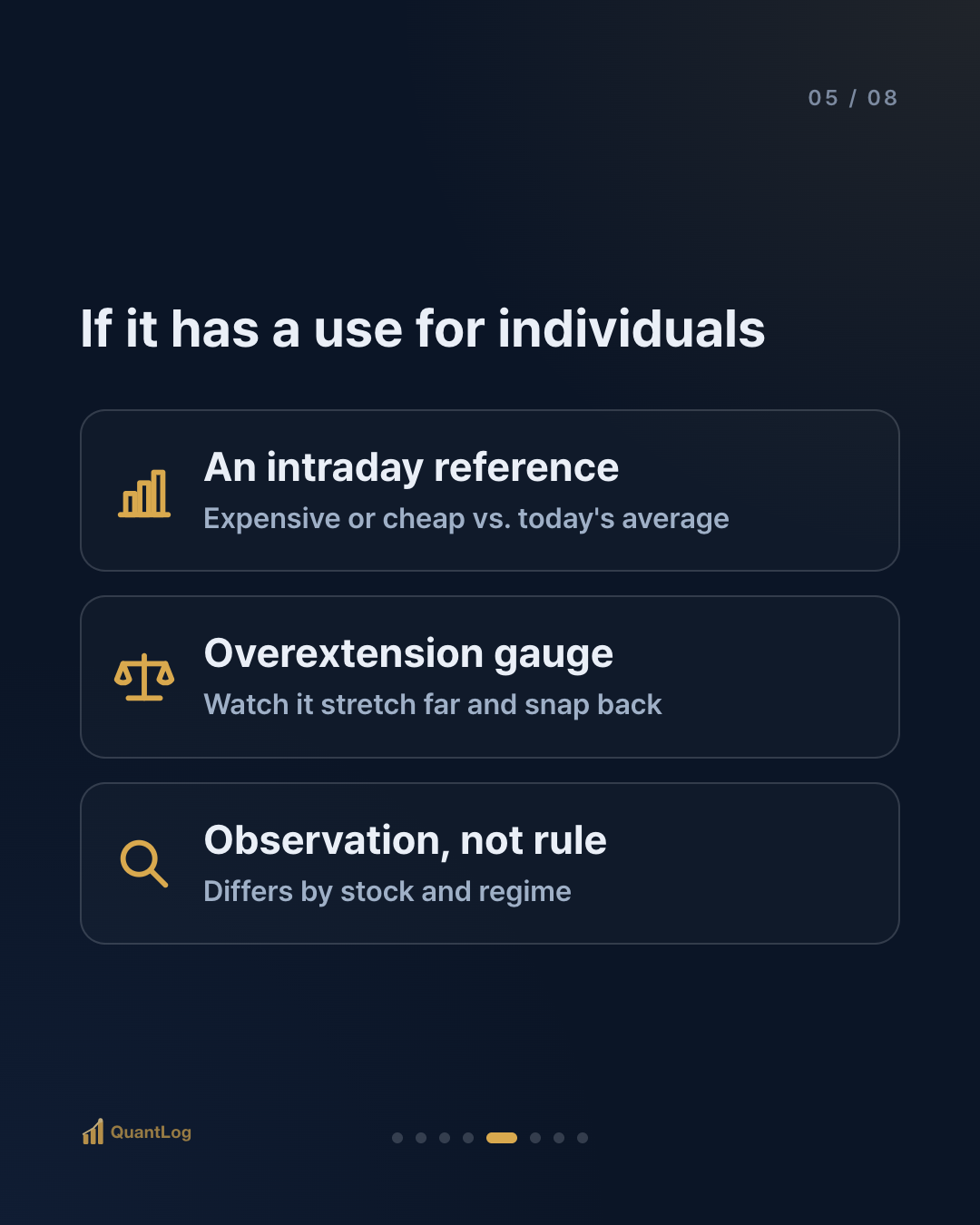
That doesn't make it meaningless for individuals. You just need to know its use precisely.
An intraday reference line. It shows at a glance whether this stock is in an expensive or cheap zone relative to today's average. In day trading, it helps you grade your own entry price.
A gauge of overextension and pullback. Some watch for the tendency of price to stretch far from VWAP and then snap back. But this too is an observation, not a rule, and it differs by stock and by regime.
The crux is one thing. VWAP is a reference line, not a prophecy. It only answers "where is now relative to today's average," not "will it rise from here."
To Sum Up
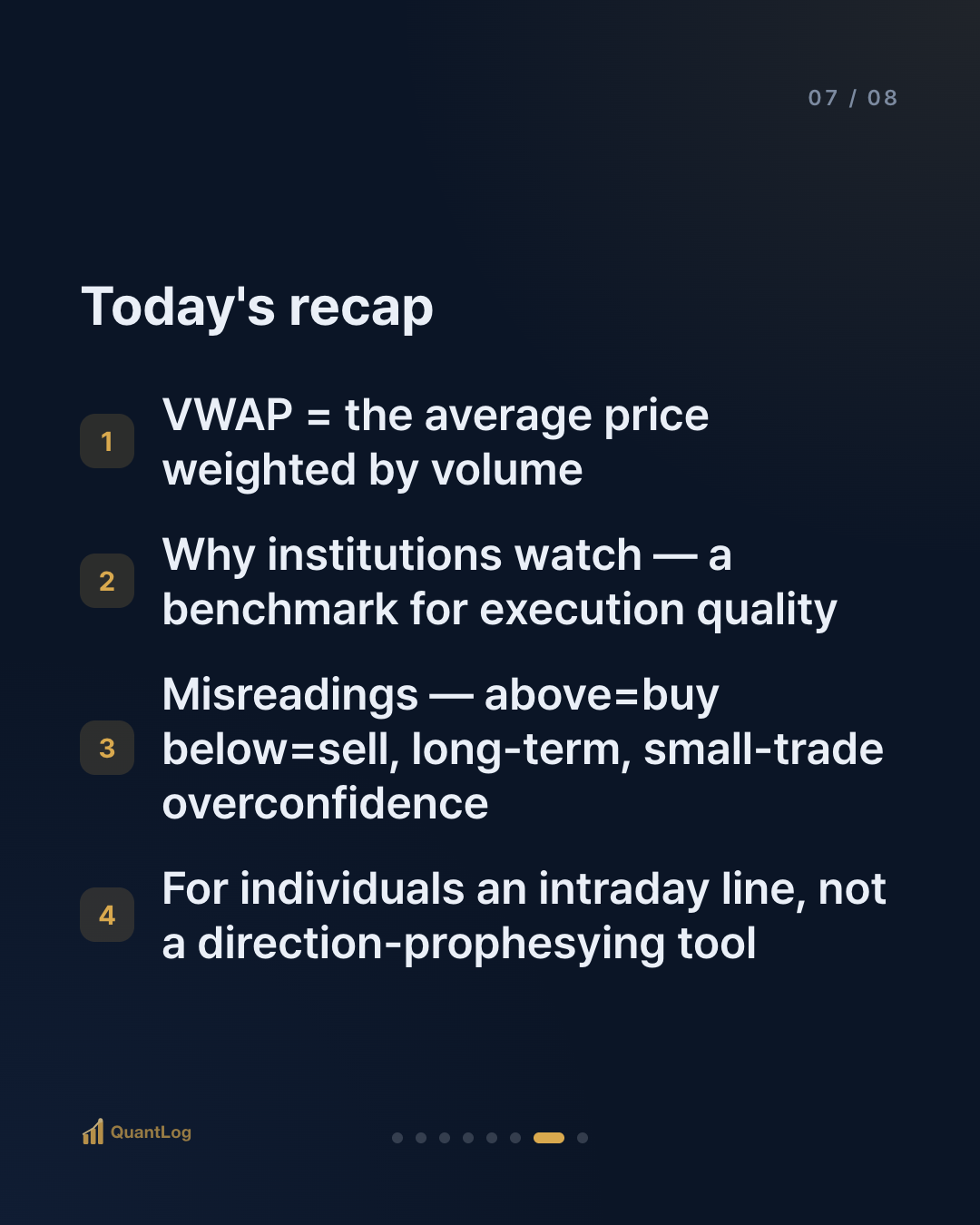
- VWAP = the average price weighted by volume. It weights the zones where a lot of shares filled
- Institutions watch it not as prophecy but as a benchmark for execution quality — does my average price beat VWAP
- Misreadings: above=buy below=sell, a long-term indicator, overconfidence in small trades. VWAP usually resets each day
- For an individual it's a value to reference as an intraday line, not a direction-prophesying tool
VWAP is a yardstick institutions built to grade their own trading. Know its origin and you can treat it not as a "magic line the institutions watch" but as the plain fact of "today's average fill price."
References
- Berkowitz, Logue & Noser, "The Total Cost of Transactions on the NYSE," *Journal of Finance* (1988) — an early discussion of the VWAP benchmark
- That VWAP serves as a performance benchmark for filling large orders is standard institutional trading practice
- The concept of volume weighting continues from issue 0010 (volume)

Disclaimer
This article is for informational purposes only and is not investment advice. It is not a recommendation to buy or sell any security. All investment decisions are your own responsibility.

Comments 0
Be the first to comment.