
There's a trade signal you'll hear again and again on stock channels and charting tutorials.
"A golden cross just printed — buy now."
The golden cross is a signal formed when two moving averages meet. But that "buy" reading becomes something you have to handle far more carefully once you understand what a moving average actually is. So let's start with what a moving average really draws.
What a moving average is, in one sentence
A moving average is exactly what the name says — a line drawn by averaging price over a set recent period. A 20-day moving average plots, each day, "the average of the last 20 closing prices." Traders commonly watch the 5, 20, 60, and 120-day lines together.
Moving average = a line connecting the average of the last N days of price
The shorter the period, the more sensitive; the longer, the smoother
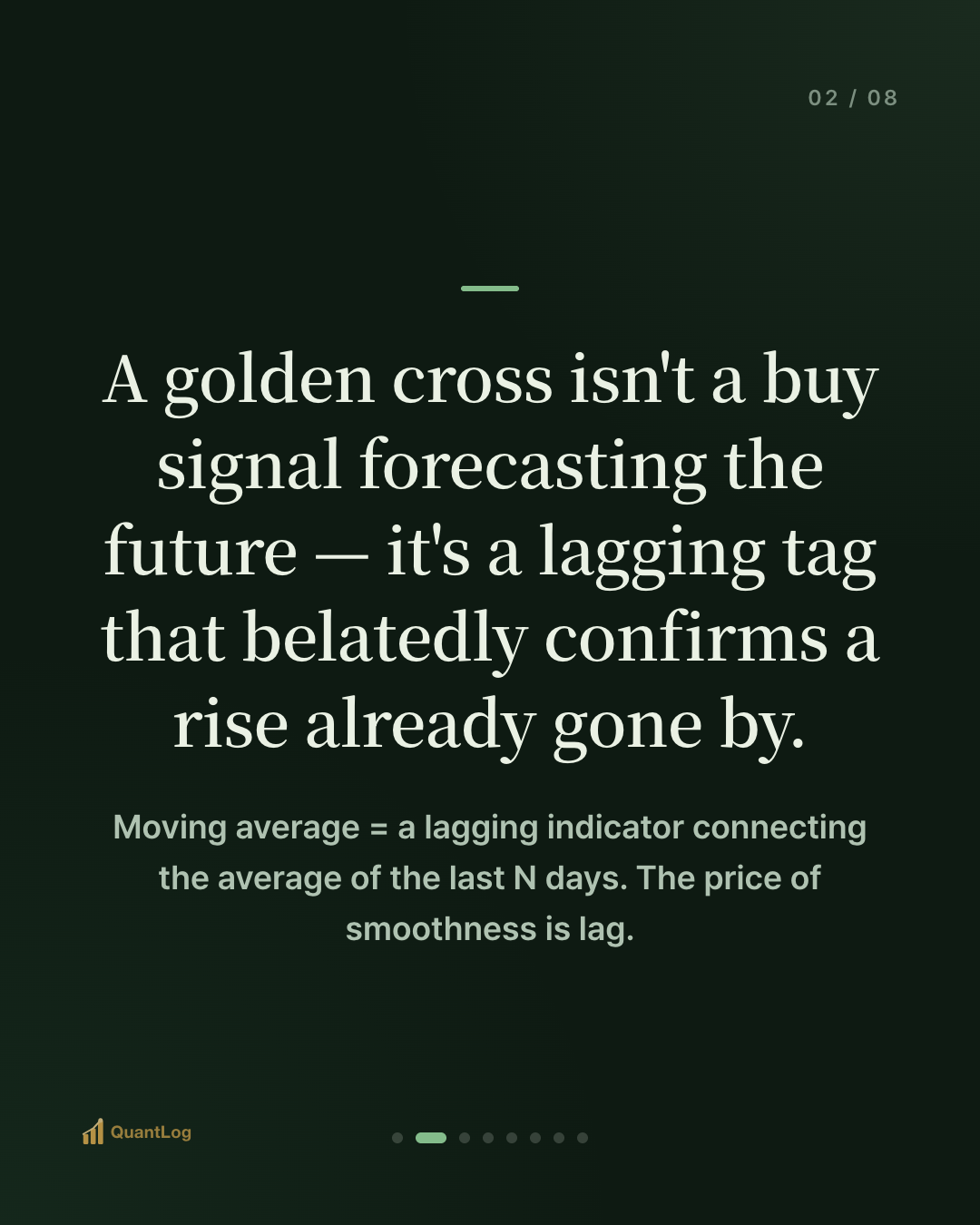
And here is a moving average's most important property. It is an average of prices that have already happened. So even when today's price turns direction, the average keeps reflecting the last several — or several dozen — days, so it turns late. An indicator like this is called a lagging indicator.
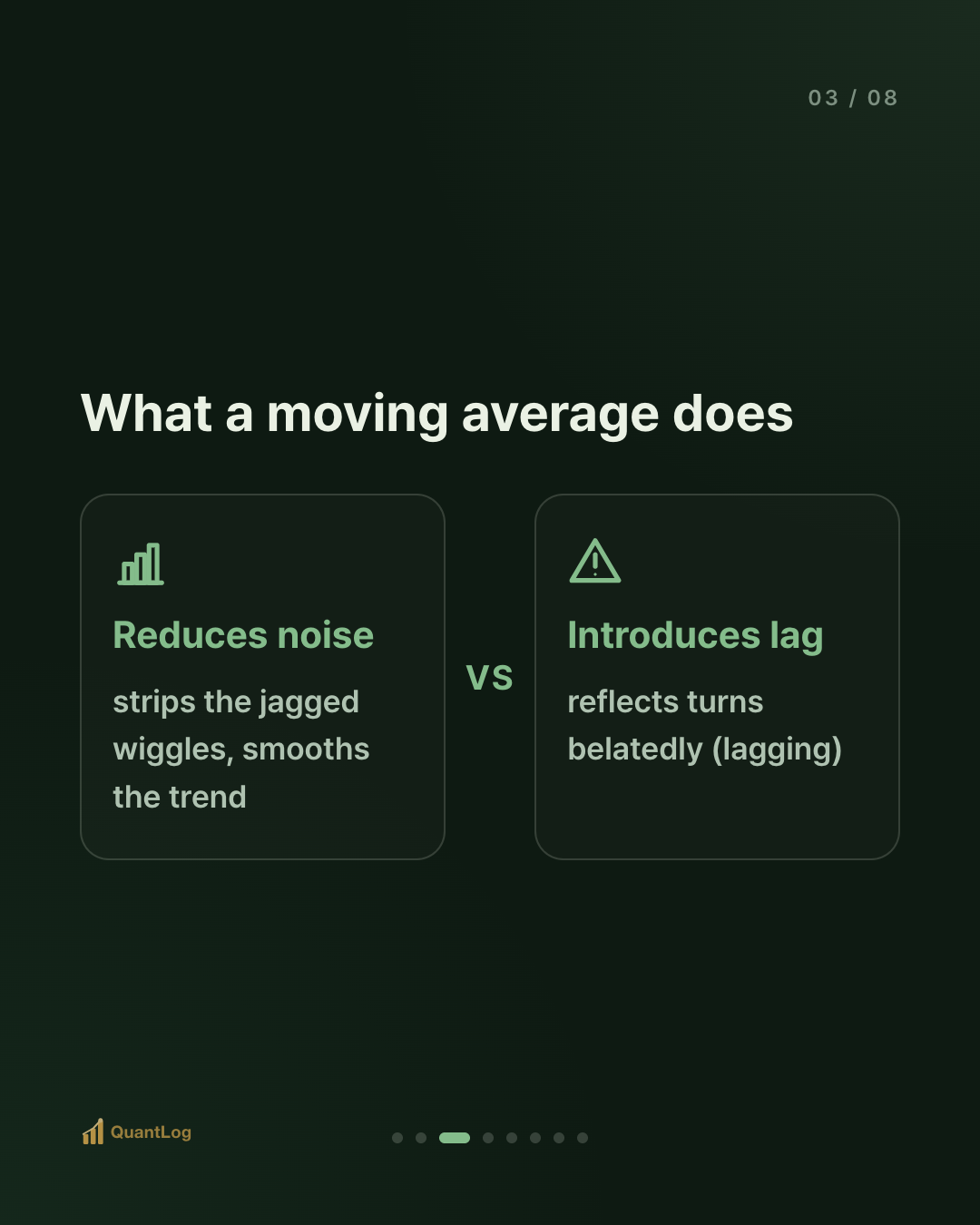
It strips out the noise (the jagged little wiggles) and shows the trend smoothly — but the price of that is lag. And that lag is the heart of the golden-cross story.
The golden cross and the death cross
The golden cross and death cross are names for the moment two moving averages of different periods cross each other.
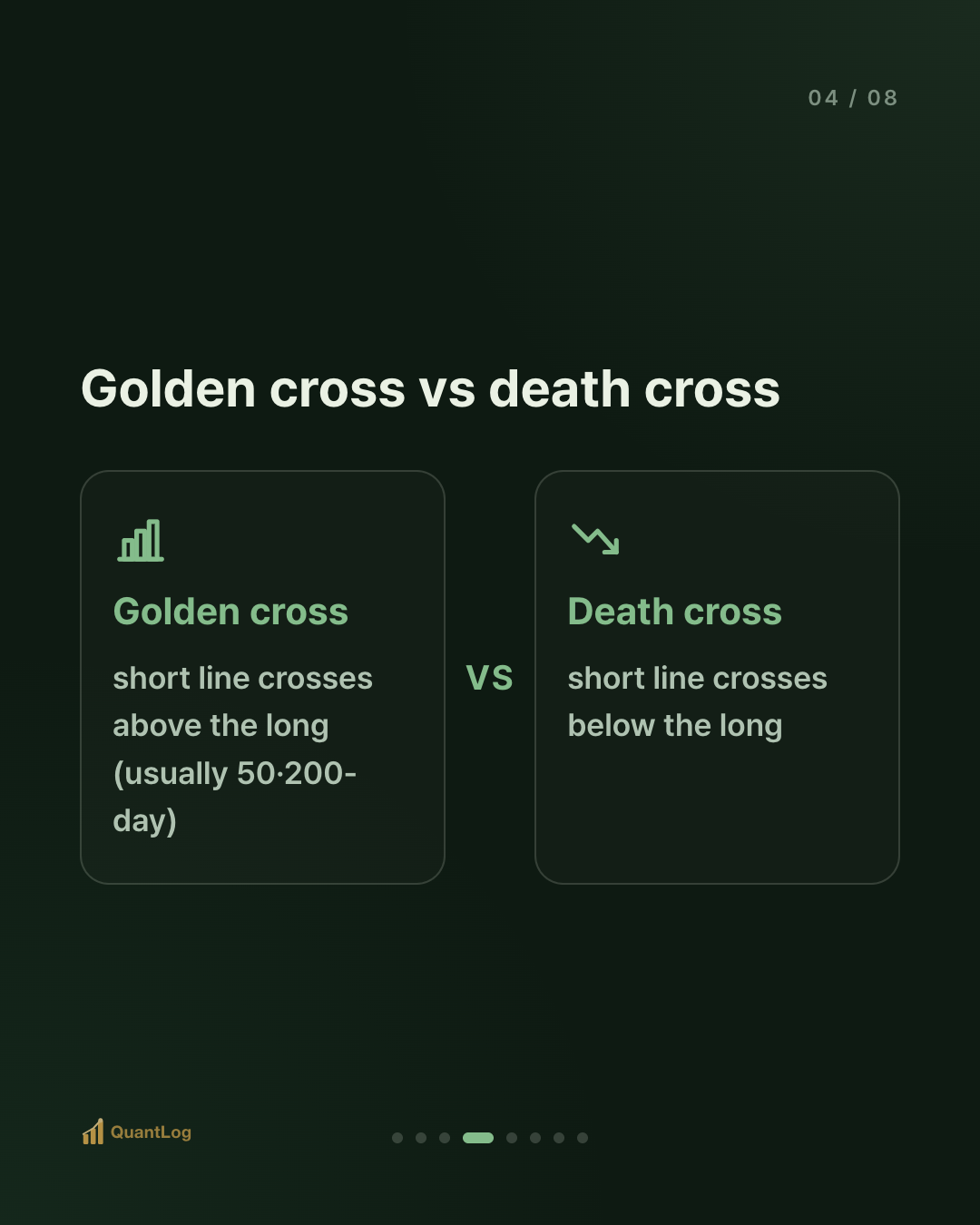
Golden cross = a shorter moving average crossing above a longer one
Death cross = the shorter line crossing below the longer one
The most widely cited pair is the 50-day and 200-day. When the 50-day rises above the 200-day it's a golden cross; when it drops below, a death cross. Many people learn the golden cross as "turning bullish = buy" and the death cross as "turning bearish = sell."
The problem shows up the moment you trace why these crosses happen at all.
Why a golden cross is not a buy button
① The golden cross is thoroughly lagging. For the short line to cross above the long line, price must have already been rising for a good while. A cross doesn't mean the advance is starting — it means it has already been underway for some time. By the time the signal prints, price is often well off the bottom.
② In a sideways market, false signals repeat. In a range with no clear trend, the two lines keep touching and separating. Each time, a golden cross and a death cross fire in short succession — and most of them reverse right away. Racking up losses by chasing these signals is called whipsaw, and it's the single biggest weakness of moving-average crosses.
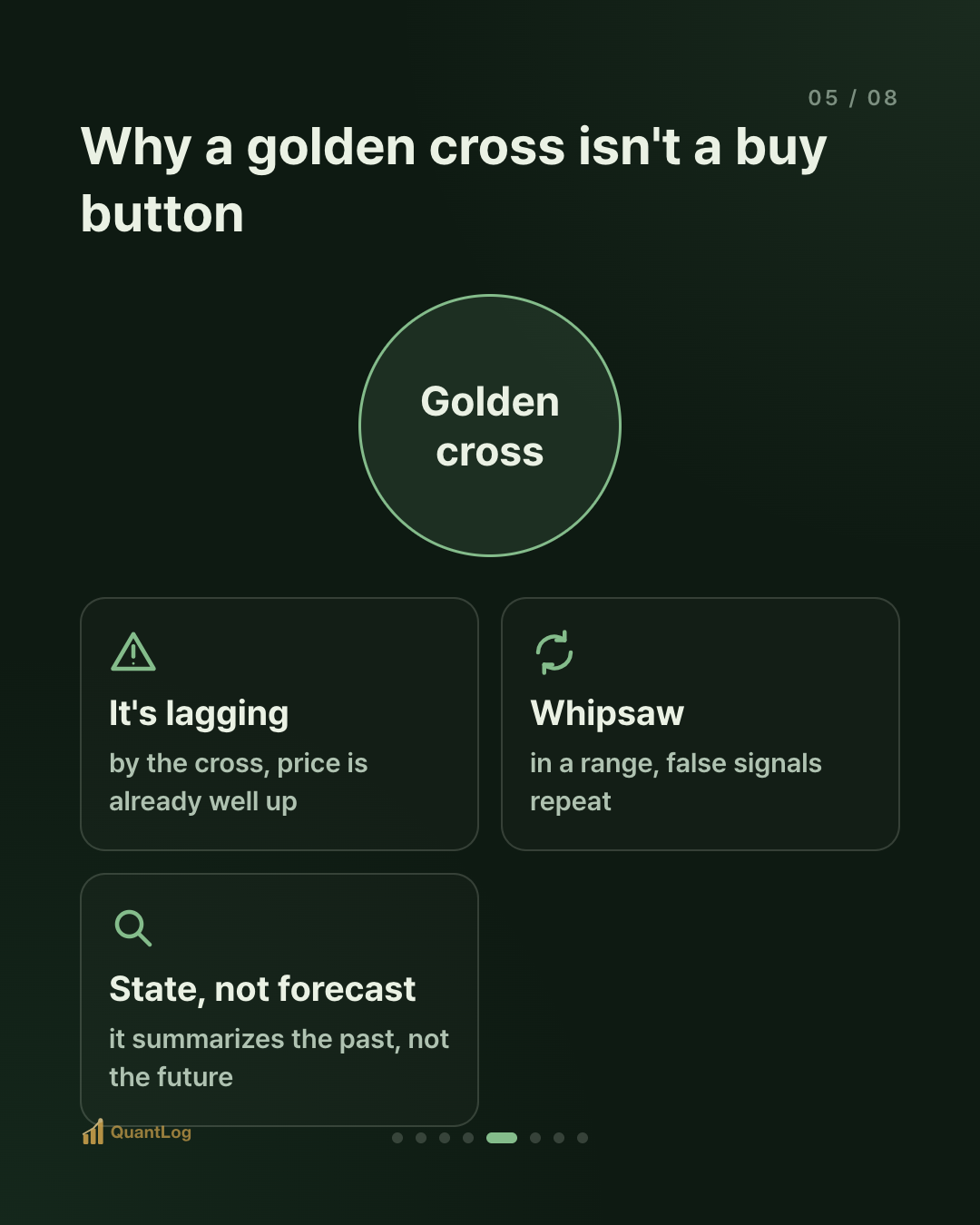
③ A cross is a description of state, not a prediction. A golden cross is not a prophecy that "it will rise from here" — it is just a summary of a past fact: "the recent short-term average has risen above the long-term average." The indicator doesn't know the future; we simply want to read it that way.
In short, a moving-average cross can be useful for confirming direction in a clear trend, but tends to cause losses in a range. Where it works and where it doesn't are quite distinct.
So how do you use a moving average?
This isn't a case for throwing it out. The moving average is the oldest, most widely used indicator, and it's useful once you know its nature. Just use it not as a "cross = trade button" but as a filter for reading the regime.
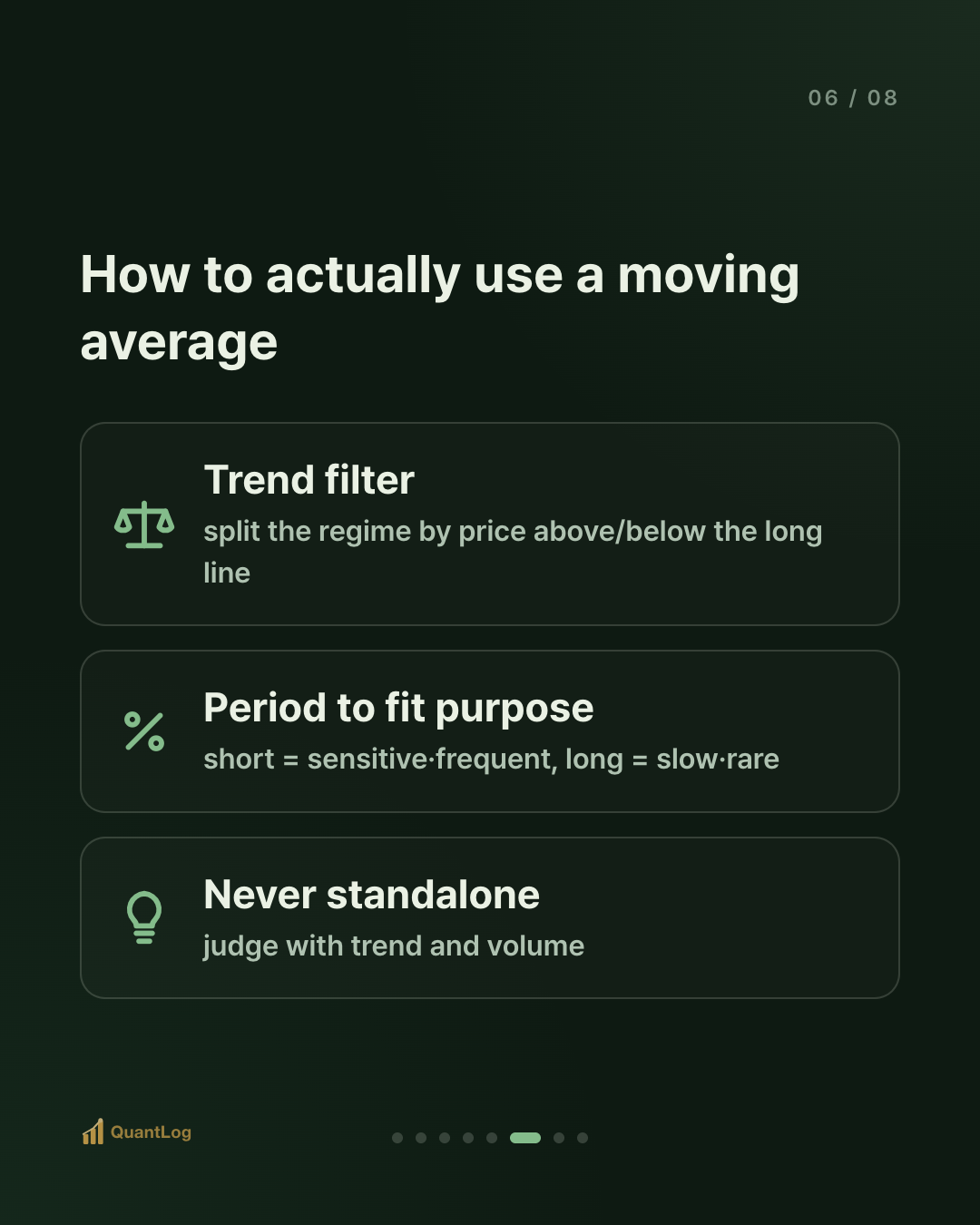
- Use it as a trend filter. If price is above the long-term moving average, call it a bullish regime; below it, a bearish one — a way to split the big picture of where you stand right now.
- Pick the period to fit your purpose. A short period is sensitive and fires often; a long one is slow and fires rarely. There is no single correct period for everyone. It's a choice between many quick signals or a few reliable ones.
- Don't use it as a standalone signal. Don't buy or sell on a golden cross alone; judge when it overlaps with other evidence like trend and volume. Above all, check whether you're in a range or a trend first — that's how you avoid whipsaw.
In short
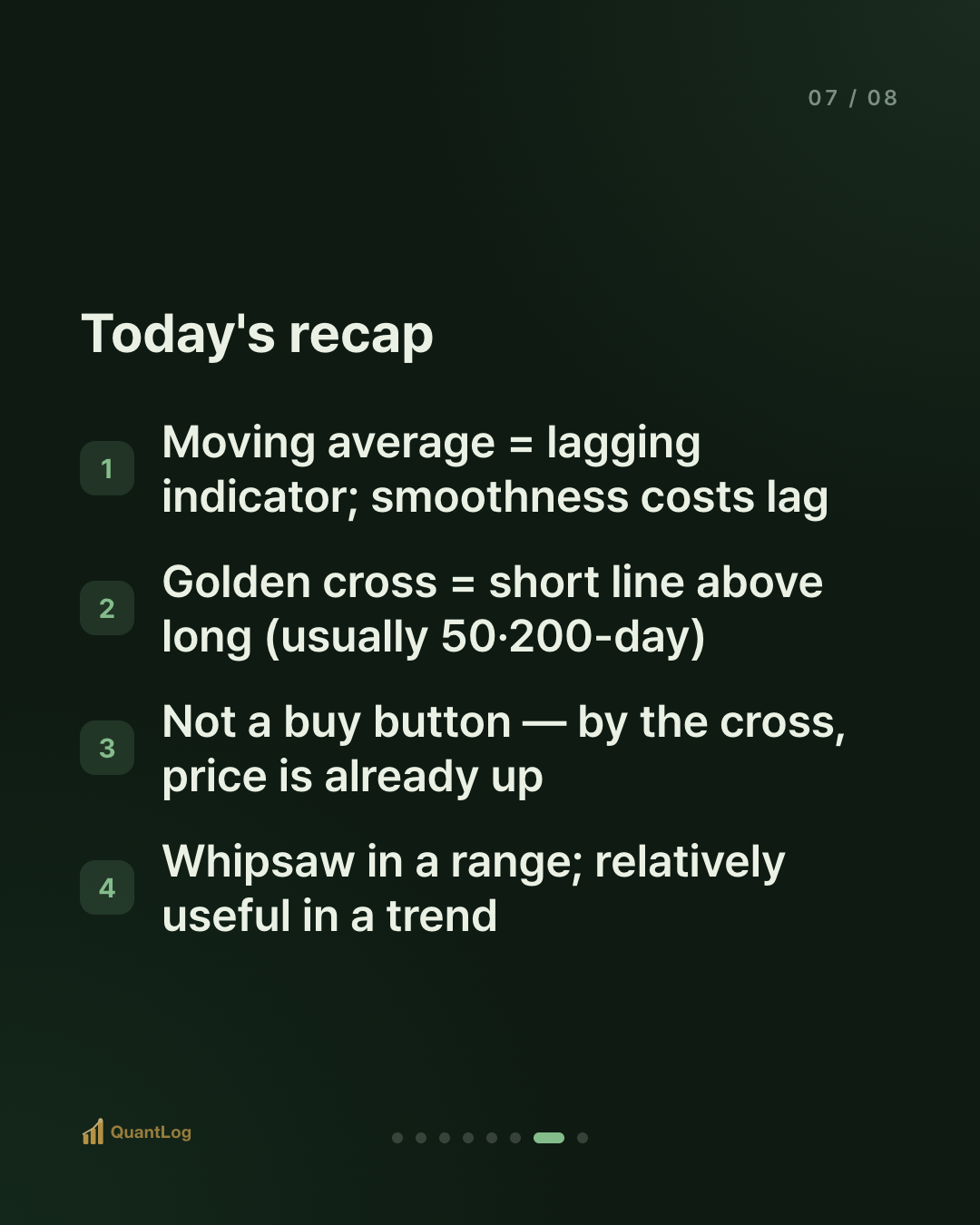
- Moving average = a lagging indicator connecting the average of the last N days of price. It reduces noise at the cost of lag
- Golden cross = the short line crossing above the long line (usually 50 and 200-day). The death cross is the reverse
- A golden cross is not a buy button. By the cross, price is already well up, and it summarizes the past, not the future
- In a range, golden and death crosses repeat and cause losses through whipsaw. It's relatively useful in a trend
- If you use it, use it as a trend filter, pick the period for your purpose, and judge direction alongside other evidence
An indicator isn't an answer, it's a summary. A moving average only summarizes, belatedly, "which way is the trend right now" — it never says "buy now."
References
- John J. Murphy, *Technical Analysis of the Financial Markets* — the lagging nature of moving averages, the definition of golden and death crosses, and the whipsaw problem in trendless markets
- Basic properties of moving averages — because a moving average is an average of past prices, it reflects turns with a lag, and a cross is a confirmation of state, not a prediction

Disclaimer
This article is for informational purposes only and is not investment advice. It is not a recommendation to buy or sell any security. All investment decisions are your own responsibility.

Comments 0
Be the first to comment.